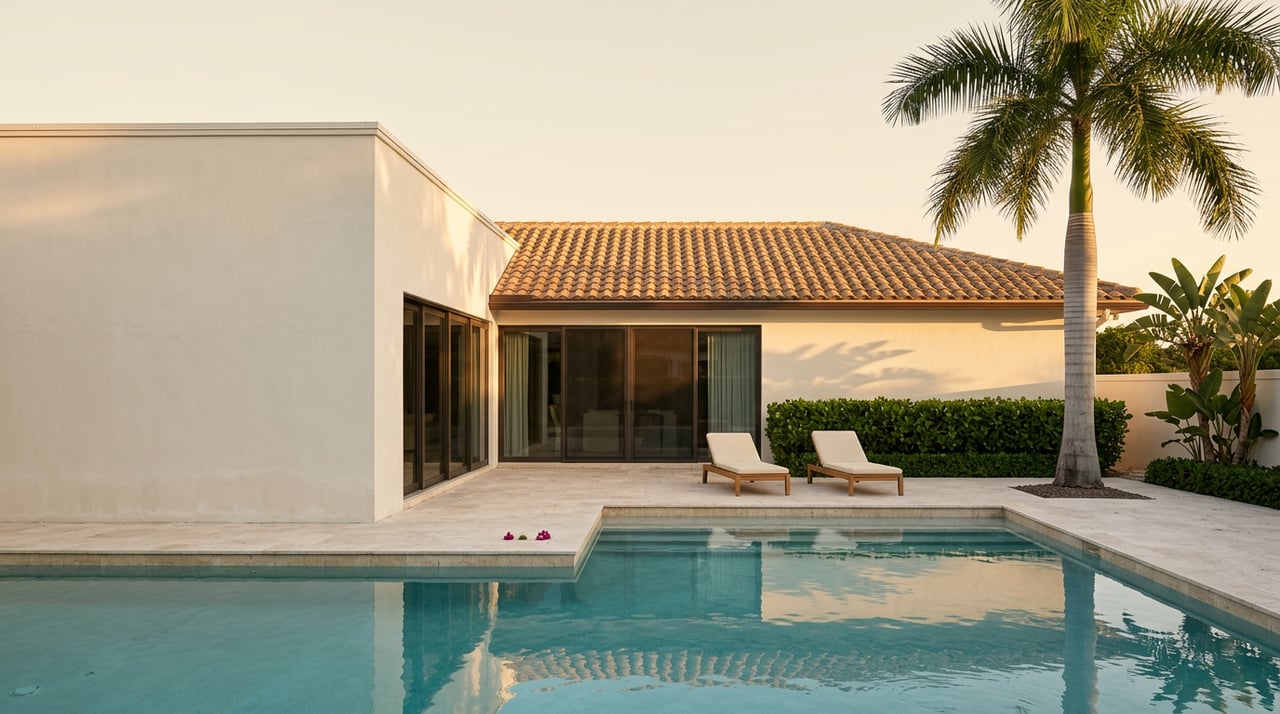
In Beach Park, Sellers Are Pricing The House. Builders Are Pricing The Lot.
Two houses on the same Beach Park block can sell four months apart for prices that don't line up with anything on a comp sheet. One goes for close to its Zillow-style estimate. The other goes for tens of thousands less than the seller expected, and the buyer never sets foot past the front door before making an offer. Both sales are legitimate. They just aren't answering the same question.
That's the split running through Beach Park right now, and it's the reason a single "median price" for the neighborhood tells you almost nothing about what your specific house is worth. Homes.com put the neighborhood's median at $1,425,000 as of February 2026, with homes spending an average of 72 days on market. Movoto's July 2026 snapshot showed a median list price closer to $1.55 million and $501 per square foot. Neither number is wrong. They're measuring two different markets that happen to share a zip code.
Beach Park's housing stock runs from 1911 to 2024, but the median build year sits around 1971 to 1973, according to Momentum Realty's analysis of Stellar MLS records as of August 2026. That means most of what's currently on the market is a 50-plus-year-old structure sitting on land that, in a lot of cases, is worth more finished as new construction than it is worth as a renovation project.
This is what creates the two-buyer split. A rehab or retail buyer is pricing the house: livable square footage, system age, kitchen and bath condition, how it stacks against other move-in-ready comps. A builder is pricing the lot: buildable footprint, elevation relative to the flood map, and what a finished new home can fetch once construction and code-compliance costs are backed out. Builders active in the neighborhood right now, including Crescent Homes, Baywalk Custom Homes, Brookshire Homes, New Legacy Homes, and Bayfair Custom Homes, aren't underwriting your roof or your 1975 kitchen. They're underwriting whether the lot, once cleared, supports a home that sells in the range Movoto's $501-per-square-foot figure suggests new construction is commanding.
Here's where the two formulas diverge in practice:
| Rehab / retail buyer | Builder / land-value buyer | |
|---|---|---|
| What sets the price | Livable square footage, finish quality, comps to move-in-ready sales | Lot size and buildable footprint, elevation relative to base flood elevation, projected finished-new-home value |
| What matters most in the file | Roof age, HVAC, permits, flood claim history | Survey, lot dimensions, zoning setbacks |
| How they treat an original 1970s interior | A cost to price down against | Largely irrelevant, since the structure is coming down |
| How fast they typically move | Financing timeline, inspection contingencies | Often faster, frequently cash |
Neither buyer is doing anything wrong. The problem is sellers who market their home to one pool while pricing it like the other, or who accept the first offer without knowing which formula produced the number.
A house with an untouched 1971 kitchen isn't being penalized for the kitchen. It's being valued for the lot underneath it. Those are two different negotiations wearing the same purchase contract.
Beach Park has been rebuilding in place for roughly two decades, largely because there's almost no vacant land left to build on fresh. That's especially visible on the Beach Park Isles peninsula, where all 84 homes were built between the 1960s and today and every new project arrives as a remodel or a full teardown and rebuild, since no empty lots remain. The same pattern shows up on interior streets: a 1957 ranch and a 2024 custom estate can sit three doors apart, both counted in the same neighborhood median.
That's the practical reason portal numbers keep disagreeing with each other. Momentum Realty's own August 2026 read shows only 15 active listings across 102 homes in the neighborhood, with 4.2 months of supply and 13% of current inventory already under contract. A sample that thin, mixing 1911 bungalows with 2024 new builds, will always produce volatile medians depending on which handful of homes closed that month. Treat any single portal figure as a starting orientation, not a comp for your specific address.
Florida's flood disclosure law adds a wrinkle that plays out differently depending on which buyer pool you're negotiating with. Since October 1, 2024, Florida Statute 689.302 has required sellers of residential property to complete a written flood disclosure form before or at contract execution, covering whether they've filed a flood insurance claim or received flood-related assistance. Effective October 1, 2025, the law expanded to also require disclosure of any flood damage during the seller's ownership, regardless of whether a claim was ever filed.
For a rehab buyer, that disclosure is core underwriting information. It shapes their financing conversation, their insurance quote, and their sense of what they're inheriting. For a builder planning to demolish and rebuild above current base flood elevation, the same document carries far less weight, since the structure's flood history isn't coming with it into the new build. The paperwork that can slow down or reprice a deal with one buyer barely registers with the other. Knowing which pool you're talking to changes how much a clean flood file is actually worth to you at the negotiating table.
The insurance stakes behind that disclosure keep rising. Tampa Bay properties in high-risk flood zones commonly carry annual flood insurance premiums in the range of $2,500 to $10,000 or more depending on elevation and construction, and as of January 1, 2026, Citizens Property Insurance now requires flood coverage for policies carrying $400,000 or more in Coverage A, regardless of flood zone designation. That mandate had been phasing in by coverage amount since 2023, and it now reaches a meaningful share of Beach Park's higher-value homes.
An elevation certificate, prepared by a licensed surveyor, documents how a structure's lowest floor sits relative to the base flood elevation on file with FEMA. Under the current Risk Rating 2.0 methodology, that certificate can only lower a flood premium or leave it unchanged. It never raises it. For a seller courting a rehab buyer, having one ready before listing removes a point of friction that can otherwise stall financing. For a seller courting a builder, it matters less directly, but it still tells the builder how much fill or pile work the rebuild will require, which factors into their offer.
Before setting a price or picking a listing strategy, it's worth running through a short gut check on which formula actually applies to your property:
None of these questions has a universally right answer. They just determine whether your best offer is likely to come from someone pricing the house or someone pricing the lot, and that distinction changes everything from your marketing photos to your negotiating posture.
Does a flood disclosure automatically lower my sale price? Not automatically. It changes how much weight the disclosure carries depending on the buyer. A rehab buyer will factor it into financing and insurance costs. A builder planning to rebuild above current flood elevation standards typically weighs it less heavily, since the existing structure's history doesn't transfer to the new build.
Should I get an elevation certificate before listing if I'm not sure which buyer I'll attract? It's rarely a bad idea. Under current NFIP rules, an elevation certificate can only help a flood insurance quote or leave it unchanged, and it gives any buyer, rehab or builder, a firmer basis for their numbers instead of guessing.
Why did one portal show my neighborhood's median price so much higher than another? Beach Park's inventory is thin and its housing stock spans more than a century of build years. A handful of new-construction closings can pull a monthly median sharply in either direction, which is why a portal snapshot is a starting point, not a substitute for pricing against your specific lot and structure.
If you're trying to figure out which buyer pool your Beach Park home actually belongs to, that's exactly the kind of pricing conversation worth having before you list. Onyx Collective works these streets block by block, and a free home valuation is the fastest way to see where your property lands.
Stay up to date on the latest real estate trends.
We bring a fresh and dynamic approach to real estate, driven by a commitment to excellence and a passion for helping our clients achieve their dreams.

3615 BROMLEY GRAND AVE #230 TAMPA FL 33607